1-2 træningspas for hele kroppen om ugen er nok for de fleste
En grundig gennemgang af det vigtigste, du bør vide om helkropstræning.
Læsetid: 15–20 minutter
Det er desværre normalt at mange tror, at de skal træne 4-5 gange om ugen for at få nogle resultater overhoved. På de sociale medier er nemt at komme til at blive overbevist om at den rigtige træning er et klassiske bodybuilding split, hvor man har bryst om mandagen, ryg om tirsdagen, skuldre om onsdagen og ben om torsdagen, arme om fredagen og hvile over weekenden.
Men for de fleste er det hverken nødvendigt eller særligt realistisk. De fleste har et arbejde, en familie, venner, hobbyer og et liv uden for træningen, er problemet sjældent, at du træner for lidt. Problemet er oftere, at du vælger en træningsplan, der kommer til at fylde mere, end din daglige rutine kan rumme.
Derfor ender mange i den samme dårlige cirkel: Man starter et ambitiøst træningsprogram, holder fast i det i et par uger, springer et par træningspas over, føler, at man er "faldet af", og starter forfra et par uger senere op og træner så hårdt som overhoved muligt for at indhente det tabte, men går død i det igen.
Det er ikke nødvendigvis et spørgsmål om manglende motivation eller viljestyrke. Planen er ofte bare lavet til en hverdag, der ikke stemmer overens for normale mennesker.
Løsningen er derfor ikke altid at presse flere træninger ind, men at vælge en struktur, der stadig fungerer, når du kun når ét eller to træningspas om ugen. Det er netop styrken ved et helkropsprogram: Du træner hele kroppen hver gang, så hvert gennemført pas dækker det vigtigste, og en travl uge ikke får hele programmet til at falde fra hinanden.
Hvad er et helkropsprogram?
Et helkropsprogram træner alle de store muskelgrupper i hver træning. I stedet for at dele kroppen over flere dage, som i et klassisk splitprogram, sammensættes hver træning af nogle få centrale bevægelser: en benøvelse, et pres, et træk og en øvelse til bagsiden af kroppen – eventuelt suppleret med lidt ekstra til arme, skuldre eller mavemusklerne.
En simpel helkropstræning kan eksempelvis bestå af hack squat, brystpres med håndvægte, lat pulldown og leg curl. Det behøver ikke være mere kompliceret end det. Det samme grundprincip kan bruges, uanset om du træner én, to eller tre gange om ugen. Det er primært antallet af sæt og den samlede ugentlige træningsmængde, der justeres.
Fordelen er, at programmet bliver mindre sårbart, når hverdagen ændrer sig. Fordi hele kroppen trænes hver gang, bliver alle de store muskelgrupper dækket i hvert gennemført træningspas. Misser du en træning, kan du derfor blot fortsætte med programmet næste gang.
I et splitprogram kan en misset bendag derimod betyde, at der går væsentligt længere tid, før benene bliver trænet igen, selvom de øvrige muskelgrupper fortsat følger planen. Det ødelægger ikke din fremgang, men det gør programmet mere skrøbeligt, når en travl uge kommer i vejen.
Hvorfor helkropstræning fungerer i en travl hverdag
Den måde vi træner på har i en lang tid været stærkt påvirket fra professionelle bodybuildere fra 90’erne og frem der havde tid til at træne 5-6 dage om ugen og op til flere gange om dagen.
Det virker helt sikkert for dem, men kun fordi de vitterligt er deres karrierevej.
De fleste af dem tog præstationsfremmende midler der hjalp dem både med træningen og resituationen. De havde en diæt rettet perfekt mod at opbygge kroppen og en stram soverutine. Dertil havde de for det meste ikke et fuldtidsarbejde, børn, og et virkeligt liv.
Det at prøve at kopiere deres træningsrutine, er som om at bruge en Michelin-koks arbejde i et køkken hver aften, når du bare skal lave aftensmad på en travl tirsdag. Værktøjet matcher ikke virkeligen.
Så istedet for at forsøge at presse alt deres træning ind i nogle lange timers rutiner, så får du træner hele kroppen hver gang. Og hvis du træner to gange om ugen, vil du ramme de samme muskler igen et par dage senere.
Helkropstræning virker for virkelige mennesker med et helt normalt ugeskema:
Du kan sagtens blive stærkere med blot 1–3 helkropstræninger om ugen.
En misset træning vælter ikke korthuset, fordi hele kroppen trænes hver gang.
Træningen fordeles bedre, så du lettere kan restituere mellem træningerne.
Du bruger mindre tid i træningscentret og har mere overskud til resten af livet.
Hvor ofte skal du træne?
Din træningsfrekvens skal passe til en almindelig uge, man kan gentage – ikke til den mest optimale uge, man håber på.
Det afgørende er ikke kun, hvor mange dage du træner. Musklerne skal udfordres tilstrækkeligt, men du skal også kunne restituere og gøre træningen til en fast del af din hverdag.
For de fleste vil 1–3 ugentlige helkropstræninger være rigeligt. Når den samlede træningsmængde er den samme, ser frekvensen i sig selv ikke ud til at have afgørende betydning for muskelvækst. Fordelen ved at træne oftere er primært, at du kan fordele arbejdet, bevare kvaliteten i sættene og eventuelt gennemføre en større samlet træningsmængde, hvilket giver meget gode resultaterne.
Mere træning er derfor ikke automatisk bedre
Træning kan sammenlignes med at vande en plante: For lidt giver ikke planten det, den har brug for, men at hælde mere vand bliver ikke ved med at skabe mere vækst. På et tidspunkt tilfører du blot mere, end planten kan optage.
Det samme gælder styrketræning. Du bliver ikke stærkere af at træne mest muligt, men af at træne tilstrækkeligt, gøre det progressivt og give kroppen tid til at tilpasse sig.
For mange betyder det 1–2 gode træninger om ugen, nogle få effektive og velvalgte øvelser, gradvis progression og en plan, der kan fungere sammen med arbejde, familie og resten af livet.
Det er måske ikke den mest imponerende plan på papiret. Til gengæld er det ofte den plan, der rent faktisk bliver til 50–100 velgennemførte træninger om året. Det er den form for kontinuitet, der skaber resultater.
Lad os derfor se på, hvad de forskellige træningsfrekvenser betyder i praksis.:
1 gang om ugen: Minimum effektiv dosis
Én ugentlig helkropstræning kan være nok til at vedligeholde styrke og - særligt for begyndere - skabe betydeligt fremgang.
Fordi hele ugens træning samles i ét træningspas, vil det typisk kræve lidt flere sæt pr. øvelse. Det gør træningen lidt længere og lidt mere krævende, men til gengæld skal den kun passes ind én gang om ugen.
Denne løsning passer især til mennesker med en pakket og travl hverdag, men stadig vil prioritere deres styrketræning. Det vigtigste er, at den ene træning bliver gennemført stabilt og indeholder nok udfordrende kvalitetssæt.
2 gange om ugen: Det bedste balance for de fleste
To ugentlige helkropstræninger giver de fleste et godt forhold mellem fremgang, tidsforbrug og restitution.
Du får mulighed for at træne hver muskelgruppe oftere og fordele arbejdet over to dage. Derfor kan du lave lidt færre sæt pr. øvelse i den enkelte træning, mens den samlede træningsmængde over ugen bliver højere.
Det betyder mindre ophobet træthed under hver træning, bedre kvalitet i sættene og flere muligheder for at øve de samme bevægelser. Samtidig er to træninger om ugen stadig realistisk at fastholde for de fleste mennesker med arbejde, børn og andre forpligtelser.
Det er derfor ofte her, du får det bedste forhold mellem indsats og udbytte.
3 gange om ugen: For de motiverede
Tre ugentlige helkropstræninger kan give hurtigere fremgang, men kun hvis du har tiden og kan restituere mellem træningerne.
Flere træningspas betyder dog ikke, at du skal udføre den samme mængde arbejde hver gang. Formålet er at fordele kvalitetsarbejdet over flere dage – ikke at lave tre gange så meget.
I programmerne i denne artikel stiger den månedlige træningsmængde eksempelvis fra 16 sæt ved én ugentlig træning til 30 sæt ved tre. Det svarer til 87,5 procent mere træning, ikke 200 procent mere.
Da hele kroppen trænes hver gang, er det en god idé at have omkring 48 timers pause mellem træningerne. Det kræver et stabilt skema, eksempelvis mandag, onsdag og fredag, så kroppen kan nå at restituere inden næste træning.
Ved tre ugentlige træninger kan du med fordel skifte mellem to helkropsprogrammer. Forskellige variationer af samme bevægelse kan lægge mere vægt på forskellige dele af en muskel. På den måde kan du skabe en bredere stimulering gennem ugen uden konstant at ændre hele programmet.
Hvorfor det giver mening at fordele træningen henover ugen
Der er især tre grunde til, at det kan være fordelagtigt at fordele arbejdet over flere træninger frem for at samle alle ugens sæt til en muskelgruppe på én dag:
(1) Chefen og medarbejderne
Dine muskler bliver styret af dit nervesystem, som aktiverer dem gennem såkaldte motoriske enheder. En motorisk enhed beståer af en nervecelle og de muskelfibre den er tilkoblet og kontrollerer.
Man kan sammenligne det med en virksomhed. Centralnervesystemet er chefen, den motoriske nervecelle ude i musklen er teamlederen, og muskelfibrene er medarbejderne. Ved en mindre krævende opgave, f.eks bare at løfte en liter mælk, er det kun nødvendigt at aktivere nogle få teams. Når opgaven kræver mere kraft, eksempelvis når du løfter tungt eller nærmer dig slutningen af et hårdt sæt, bliver flere og større teams inddraget.
Efter mange sæt til den samme muskelgruppe begynder medarbejdernes arbejdskapacitet midlertidigt at falde. Nervesystemet forsøger at opretholde kraften ved at aktivere flere motoriske enheder, men efterhånden falder både præstationen og kvaliteten af sættene. Du kan stadig fortsætte træningen, men kraftproduktionen, kontrollen og kvaliteten af arbejdet vil typisk falde.
Derfor kan fire gode sæt mandag og fire gode sæt torsdag give en højere gennemsnitlig kvalitet end otte sæt samlet på én dag. Det betyder ikke, at de sidste sæt er værdiløse, men hvert ekstra sæt bidrager ofte med mindre stimulus i forhold til den træthed, det skaber.
(2) En ny opbygningsrespons efter hver træning
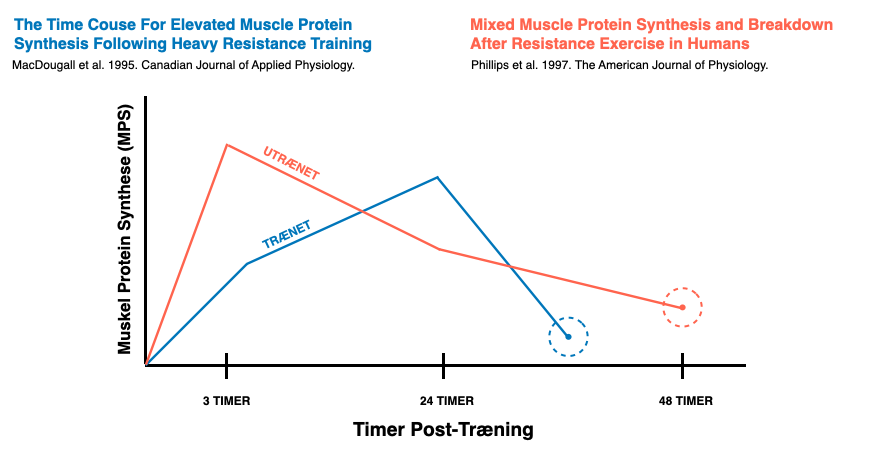
Når du styrketræner en muskel, stiger muskelproteinsyntesen – en proces i kroppen, der bidrager til at reparere og opbygge den trænet muskelvæv efter træningen. Responsen er forhøjet i en periode og falder derefter gradvist tilbage mod udgangspunktet. Hvor længe den varer, afhænger blandt andet af din træningserfaring og af, hvor uvant og krævende træningen har været.
Træner du eksempelvis hele kroppen mandag og torsdag, udsætter du de samme muskelgrupper for to separate træningsstimuli. I stedet for at samle alt arbejdet på én dag skaber du dermed en ny opbygningsrespons senere på ugen.
Det betyder ikke, at en muskel skal trænes igen, så snart muskelproteinsyntesen falder, eller at to træninger automatisk giver dobbelt så meget muskelvækst. Frekvensen er først og fremmest et redskab til at fordele træningsmængden. Det kan gøre det lettere at gennemføre flere effektive sæt, begrænse den ophobede træthed og restituere mellem træningerne.
(3) Styrketræning kræver øvelse
Styrke afhænger ikke kun af musklernes størrelse. Den afhænger også af, hvor effektivt du kan koordinere bevægelsen, stabilisere kroppen og producere kraft i den konkrete øvelse.
En squat, brystpres eller pulldown er derfor også en færdighed. Nervesystemet skal lære bevægelsesbanen, timingen og fordelingen af kraft mellem de involverede muskler.
Det kan sammenlignes med at lære et stykke på klaver. Du bliver sjældent bedst til det ved at øve længe én dag og derefter lade klaveret stå urørt resten af ugen. Når øvelsen fordeles over flere dage har du et mere frisk sind gående ind i opgaven, er det lettere at huske det, du lærte sidst, rette små fejl og gradvist gøre bevægelsen mere sikker.
Træner du en øvelse én gang om ugen, får du omtrent fire muligheder for at øve den på en måned. Træner du den to gange, får du omtrent otte. Det giver ikke nødvendigvis dobbelt så meget læring, men det giver flere muligheder for at bygge videre, mens bevægelsen stadig føles velkendt.
Når sættene samtidig fordeles over flere kortere træninger, udfører du en større del af dem, mens du stadig er frisk. Det gør det lettere at gentage en stabil teknik, følge din fremgang og gradvist blive stærkere i de samme bevægelser.
Sådan bygger man et effektivt helkropsprogram
Formålet med et effektiv helkropsprogram er ikke at opfinde vilkårlige øvelser eller piske dig igennem en udmattende cirkeltræning bare for at gøre dig træt.
I stedet for så tager vi udgangspunkt i hvilke store bevægelser kroppen kan lave, som kan bruges af alle, men dog justeret ift dine specifikke mål, erfaring og din skadeshistorik.
At bygge fundamentet først
Jeg har mødt mange mennesker der aldrig har haft en god eller positiv erfaring med styrketræningslokalet. Måske føltes det intimiderende og forvirrende, hvilket har ledt til en ubehagelig oplevelse. Det er synd og derfor vil jeg gerne ændre det!
Jeg vil gerne have dig til at tænke: “Det her, det kan jeg holde fast i.”
Når du er ny til styrketræning, er vores største fokus ikke at løfte så tungt som muligt i starten. Det er at få dig til at blive komfortabel, selvsikker og i kontrol i de valgte øvelser.
Det gør vi igennem at få etableret god træningsteknik, håndtere eventuelle mobilitetsproblemer fra starten, bygge selvtillid gennem håndterbare vægte og fokusere på et lille antal øvelser indtil du virkelig er god til dem. Det giver dig nemlig tid til at dit nervesystem, led og bindevæv kan tilpasse sig ordentligt.
At bygge videre - lidt af gangen
Når øvelserne føles velkendte, teknikken er stabil, og du er klar igen til næste træning, begynder vi gradvist at skrue op.
Det sker ikke gennem store spring. Først kan fremgang være en ekstra gentagelse med samme vægt. Når du kan udføre alle dine sæt sikkert og kontrolleret i toppen af gentagelsesintervallet, øger vi belastningen en smule og bygger op igen derfra.
Vi holder fast i de vigtigste øvelser, så du får tid til at blive virkelig god til dem. Det gør det muligt at måle din udvikling og skelne reel fremgang fra almindelige udsving fra træning til træning.
Målet er at give kroppen en tilstrækkelig grund til at blive stærkere uden at skabe mere træthed, end du kan nå at restituere fra. Derfor skal sættene være udfordrende, men de behøver ikke ende i en stor struggle hver gang.
Hvis du øger for hurtigt, risikerer du, at teknikken forringes, trætheden ophobes unødvendigt, og fremgangen går i stå. En mere tålmodig progression kan virke mindre imponerende fra uge til uge, men den giver dig mulighed for at fortsætte måned efter måned.
Fremgang skabes ikke af enkelte heroiske træninger, men af mange gode træninger, du kan bygge videre på.
Organiseringen af øvelserne: A/B/C/D
Ved at vi organiserer øvelserne i kategorier parre vi dem sammen, som et træk og pres, og skifter mellem dem under træningen med en passende pause i mellem. På den måde sparer vi masse tid uden at gå på kompromi med præstationen.
A-Serie (Pres & Træk)
Maskine Bryst Pres
Skulder Pres med håndvægte
Kabel Pulldown
Kabel Træk
B-Serie (Squat + Ben Træk)
Hack Squat
Split Squat
Liggende Ben Træk
Romænske Dødløft
C-Serie (Isolering af Underkrop & Skuldre)
Leg Extension
Glute Brigde
Lateral Raise med håndvægte
Lateral Raise med Kabel
D-Serie (valgfrit arm & mave)
Incline Dumbbell Curl
Cable Tricep Extension
Reverse Ab Curls
Vi udfører typisk 2–4 sæt pr. øvelse. Det præcise antal afhænger af, hvor ofte du træner, din erfaring, den tid du har til rådighed, og hvor meget træning du kan restituere fra.
Øvelserne bliver sammensat, så hele kroppen trænes på 45–60 minutter uden unødigt hastværk. Samtidig begrænser vi overlap mellem de arbejdende muskelgrupper, så du kan bevare kvaliteten gennem hele træningen.
Hver træning følger en tydelig struktur, og dine sæt, gentagelser og belastninger bliver registreret. Du skal derfor ikke være i tvivl om, hvad du skal lave, eller om træningen var tilstrækkelig. Det, du præsterer i dag, giver os et konkret udgangspunkt for næste træning.
Resultatet er et enkelt og målrettet helkropsprogram, der udvikler hele kroppen uden at kræve, at træningen overtager din hverdag.
Faste rammer gør fremgang målbar
Et træningsprogram skal ikke kun få dig til at føle, at du har arbejdet hårdt, men også gøre det muligt at vurdere, om du rent faktisk bliver stærkere. Derfor holder vi som udgangspunkt øvelser, bevægelsesudslag, teknik og pauser nogenlunde ens fra gang til gang, så resultaterne fra træningerne kan sammenlignes.
Hvis du skal udføre en ny brystøvelse hver uge, skal den først introduceres og tilpasses, hvorefter du skal finde den rette indstilling, bevægelsesbane og belastning. Når du endelig har lært øvelsen at kende, skifter programmet igen, og processen begynder forfra. Ved at gentage den samme øvelse kan du i stedet bygge videre på din seneste præstation og bruge mere af træningen på at skabe reel fremgang.
Efter omkring 12 uger kan det give mening at vurdere, om enkelte øvelser skal udskiftes, men uge 12 er ikke en automatisk udløbsdato. Hvis en øvelse fungerer godt og fortsat kan udvikles, er der ingen grund til at ændre den. Ved konstant at skifte øvelser risikerer du en form for pseudofremgang, hvor du hurtigt forbedrer dig, fordi du bliver bedre til den nye bevægelse, uden at det nødvendigvis betyder, at din generelle styrke eller muskelmasse er steget tilsvarende.
Sæt og Reps
I de fleste øvelser arbejder vi med 6–8 gentagelser og 2–4 sæt, hvilket giver en praktisk balance mellem belastning, kontrol og tidsforbrug. Sættene afsluttes typisk med 1–2 gode gentagelser i reserve, mens pausen som udgangspunkt er omkring to minutter og tilpasses efter øvelsens krav. Når både udførelse og pauser er nogenlunde ens, bliver det lettere at skelne reel fremgang fra almindelige udsving.
Hvis du udførte seks kontrollerede gentagelser med 80 kg i sidste uge og kan udføre syv under de samme betingelser i denne uge, er det derfor ikke bare en god fornemmelse, men målbar fremgang.
Først flere gentagelser – derefter mere vægt
Progressionen følger en enkel model. Du beholder den samme belastning og forsøger gradvist at bevæge dine sæt fra seks mod otte gentagelser.
Et forløb i brystpres kan eksempelvis se sådan ud:
80 kg × 6, 6 og 6
80 kg × 7, 7 og 6
80 kg × 8, 7 og 7
80 kg × 8, 8 og 8
Når alle sæt når otte gentagelser med god kontrol, øger vi belastningen. Herefter begynder du igen omkring seks gentagelser og bygger op på ny.
I begyndelsen kan denne udvikling ske hurtigt, fordi du både bliver stærkere og bedre til selve øvelsen. Senere kan én ekstra gentagelse tage flere uger. Det er ikke et tegn på, at træningen er holdt op med at virke. Det er en naturlig konsekvens af, at du allerede er blevet stærkere.
Træningsloggen bevæger sig i hele gentagelser og faste vægtspring. Kroppens udvikling sker derimod gradvist. Derfor kan du godt have forbedret dig, selvom tallene endnu ikke er store nok til at ændre sig.
Hvordan langsigtet træning ser ud
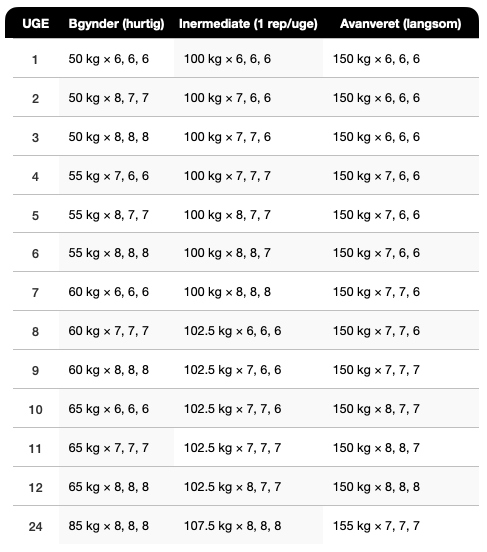
Når man begynder at styrketræne kan man tilføje vægt de første par uger, hvor det senere vil tage længere mellem vægtøgningerne, hvor avanceret løftere nok bruger den samme vægt for måneder før de går op.
Det er sådan styrketræning fungerer når man bliver mere øvet, hvilket er helt normalt.
Men det ændrer også ens mindset om hvordan man tænker om fremgang. Pludselig stopper man med at forvente linear forbedringer og begynde at sætte pris på lidt mindre gains som sammensat over tid hober sig op.
På tabellen vil man kunne se hvordan udviklingen i gentagelser og efterøflgende vægtægning forløber sig for tre niveauer, e.g. begynder, intermediate & avanceret.
Gratis Helkropstræningsprogram til 1, 2 og 3 ugentlige træninger
Program til én ugentlig træningspas for hele kroppen
Dette program er til dig, der har en pakket eller uforudsigelig hverdag, men stadig gerne vil prioritere din styrketræning. Én ugentlig træning er ikke den hurtigste vej til fremgang, men den kan være langt mere effektiv end et større program, du ikke får gennemført.
Når hele kroppen kun trænes én gang om ugen, skal træningen dække det vigtigste. Programmet består derfor af seks øvelser, som tilsammen træner bryst, ryg, skuldre og de store muskelgrupper i benene.
Træningen kan placeres på den dag, der passer bedst. En fast ugedag gør det ofte lettere at skabe en rutine, men programmet falder ikke fra hinanden, hvis træningen enkelte uger må flyttes.
A-Serie
A1: Brystpres i maskine – 4 sæt × 6–8 gentagelser
A2: Pulldown – 4 sæt × 6–8 gentagelser
B-Serie
B1: Hack squat – 4 sæt × 6–8 gentagelser
B2: Liggende Leg Curl – 4 sæt × 6–8 gentagelser
C-Serie
C1: Lateral Raise med håndvægte – 3 sæt × 6–8 gentagelser
C2: Leg Extension – 3 sæt × 6–8 gentagelser
Forventet varighed: Cirka 60 minutter.
De primære øvelser får fire sæt, fordi hele ugens arbejde skal samles i denne ene træning. De mindre isolationsøvelser får tre sæt, så passet stadig kan gennemføres på omkring en time uden at ende i unødvendig udmattelse.
Sættene udføres med omtrent 1–2 gode gentagelser i reserve. Når du kan gennemføre alle sættene med otte kontrollerede gentagelser, øger du belastningen en smule og begynder igen omkring seks.
Målet er ikke at presse mest muligt arbejde ind i én træning. Det er at prioritere de øvelser, der giver mest værdi, og udføre dem stabilt nok til, at du kan bygge videre fra uge til uge.
Program til to ugentlig træningspas
Dette program er til dig, der kan afsætte to faste tidspunkter om ugen og ønsker hurtigere fremgang, uden at træningen skal fylde det hele.
Ved at træne kroppen to gange om ugen kan du fordele arbejdet over flere dage. Det betyder færre sæt pr. træning, mindre ophobet træthed og flere muligheder for at øve de samme bevægelser. For mange er det en god balance mellem fremgang, restitution og tidsforbrug.
Placér træningerne på to ikke-sammenhængende dage med cirka 48–72 timers mellemrum – eksempelvis mandag og torsdag.
A-Serie
A1: Brystpres i maskine – 3 sæt × 6–8 gentagelser
A2: Pulldown – 3 sæt × 6–8 gentagelser
B-Serie
B1: Hack squat – 3 sæt × 6–8 gentagelser
B2: Liggende leg curl – 3 sæt × 6–8 gentagelser
C-Serie
C1: Lateral raise – 2–3 sæt × 6–8 gentagelser
C2: Leg extension – 2–3 sæt × 6–8 gentagelser
D-Serie – valgfri
D1: Incline dumbbell curl – 2 sæt × 6–8 gentagelser
D2: Overhead cable triceps extension – 2 sæt × 6–8 gentagelser
Forventet varighed: Cirka 60 minutter.
De primære øvelser udføres med tre sæt, hvilket giver seks ugentlige sæt til de vigtigste bevægelsesmønstre. Det er nok til at skabe fremgang for mange, uden at den enkelte træning bliver unødigt lang eller udmattende.
Hvis du udelader den valgfrie D-serie, kan du udføre tre sæt i C-serien. Tilføjer du øvelserne til arme, kan du reducere C-serien til to sæt og dermed holde træningen inden for cirka en time.
De fleste sæt afsluttes med omtrent 1–2 gode gentagelser i reserve. Når du kan gennemføre alle sættene med otte kontrollerede gentagelser, øger du belastningen en smule og begynder igen omkring seks.
Målet er to fokuserede træninger, der er krævende nok til at skabe fremgang, men overskuelige nok til at blive en stabil del af din uge.
A/B-program til tre ugentlige træninger
Dette program er til dig, der allerede har en stabil træningsrutine og kan afsætte tre faste tidspunkter om ugen. Den ekstra træning giver mulighed for at fordele arbejdet over flere, kortere træningspas og øve bevægelserne oftere.
Fordi du træner tre gange om ugen, behøver hvert træningspas ikke indeholde lige så mange sæt. Det betyder, at en større del af arbejdet kan udføres, mens du stadig er frisk, og at trætheden fra den enkelte træning bliver lettere at håndtere.
Placér træningerne med cirka 48–72 timers mellemrum – eksempelvis mandag, onsdag og fredag.
A-serie
A1: Brystpres i maskine – 2–3 sæt × 6–8 gentagelser
A2: Pulldown – 2–3 sæt × 6–8 gentagelser
B-serie
B1: Hack squat – 2–3 sæt × 6–8 gentagelser
B2: Siddende leg curl – 2–3 sæt × 6–8 gentagelser
C-serie
C1: Lateral raise – 2 sæt × 6–8 gentagelser
C2: Leg extension – 2 sæt × 6–8 gentagelser
D-serie – valgfri
D1: Incline dumbbell curl – 2 sæt × 6–8 gentagelser
D2: Overhead cable triceps extension – 2 sæt × 6–8 gentagelser
Forventet varighed: Cirka 45–60 minutter.
Start som udgangspunkt med to sæt pr. øvelse. Træner du tre gange om ugen, giver det allerede seks ugentlige sæt til hvert af de primære bevægelsesmønstre. Et tredje sæt kan tilføjes til de vigtigste øvelser, hvis du restituerer godt og har behov for mere træningsmængde.
Programmet kan gentages ved alle tre træninger. Du kan også skifte mellem to faste programvarianter efter modellen A–B–A den ene uge og B–A–B den næste. Det giver lidt mere variation, uden at øvelserne ændres så ofte, at det bliver vanskeligt at følge din fremgang.
De fleste sæt afsluttes med omtrent 1–2 gode gentagelser i reserve. Når du kan gennemføre alle sættene med otte kontrollerede gentagelser, øger du belastningen en smule og begynder igen omkring seks.
Alle tre programmer kan skabe fremgang. Forskellen ligger i den mulige træningsmængde og hastighed – men også i, hvor meget tid, planlægning og restitution de kræver.
Hjemmetræningsprogram som reserveplan.
Et enkelt alternativ til at springe træningen over. Hjemmetræningen er beregnet til de perioder, hvor dit normale program ikke kan gennemføres. Det kan være på en rejse, under en travl arbejdsuge eller hjemme med et sygt barn.
Programmet skal ikke nødvendigvis erstatte din almindelige styrketræning. Det fungerer som en reserveplan, der hjælper dig med at bevare rutinen og træne hele kroppen med begrænset udstyr.
A-serie
A1: Push-ups – 3 sæt × 8–15 gentagelser
A2: Omvendt roning i TRX eller ringe – 3 sæt × 6–12 gentagelser
B-serie
B1: Split squat – 3 sæt × 8–12 gentagelser pr. ben
B2: Etbens glute bridge – 3 sæt × 8–12 gentagelser pr. ben
C-serie
C1: Planke – 3 sæt × 30–60 sekunder
C2: Lateral raise med elastik – 2 sæt × 10–15 gentagelser
Forventet varighed: Cirka 35–45 minutter.
Har du adgang til en håndvægt, kan flere af øvelserne nemt opgraderes. Omvendt roning kan erstattes af enarms rows, split squats kan udføres med håndvægten i hånden, og glute bridges kan belastes ved at placere den over hoften. Du kan også bruge håndvægten til lateral raises.
Har du en kettlebell, kan glute bridge desuden erstattes af rumænsk dødløft. Det giver dig en mere krævende hoftehængselsøvelse, som især træner baglår, baller og rygstrækkere. Hvis vægten er let, kan øvelsen udføres på ét ben for at øge belastningen på hvert ben.
Det gør belastningen lettere at styre og giver flere muligheder for at skabe målbar progression. Du kan gradvist tilføje gentagelser, øge bevægelsesudslaget eller vælge en mere krævende øvelsesvariant. Hvis du ikke har adgang til mere vægt, kan elastikker, en belastet rygsæk, et langsommere tempo eller korte pauser i øvelsens sværeste position bruges til at øge udfordringen.
Mulighederne for langsigtet progression vil stadig være mere begrænsede end i et træningscenter. Som midlertidig løsning kan programmet dog hjælpe dig med at bevare både styrke, bevægelsesrutine og kontinuitet.
Det bedste program er ikke det, der passer til din mest ambitiøse uge. Det er det, du kan gennemføre stabilt i den hverdag, du faktisk har.
Den bedste plan er den, du stadig følger om 6 måneder.
Mange leder efter det perfekte træningsprogram. Men et program er kun godt, hvis det passer til den tid, energi og restitution, du faktisk har til rådighed – også i de uger, hvor hverdagen ikke går som planlagt.
Hvis du realistisk kan træne en eller to gange om ugen, skal programmet bygges omkring det. Når planen ikke konstant kræver, at du indhenter mistede træninger eller begynder forfra, bliver styrketræning lettere at gøre til en fast del af hverdagen.
Én eller to ugentlige træninger bliver til omkring 50–100 træningspas på et år. Det er mange muligheder for at forbedre teknikken, tilføje gentagelser, øge belastningen og gradvist blive stærkere.
Resultaterne kommer sjældent fra enkelte, ekstraordinære træninger. De kommer fra det arbejde, du kan gentage gennem måneder og år.
Det er ikke nødvendigvis den mest ambitiøse plan, der virker bedst. Det er den, der kan holde til virkeligheden.
Vil du træne med mig?
Book en gratis opstartssamtale og lær, hvordan vi strukturerer træningen omkring simple, gentagelige bevægelser, der skaber reel langsigtet fremgang.
References
Fisher, J., Steele, J., & Smith, D. (2013). Evidence-based resistance training recommendations for muscular hypertrophy. Medicina Sportiva, 17(4), 217–235. https://www.researchgate.net/publication/228830087_Evidence-Based_Resistance_Training_Recommendations
Gentil, P., Fisher, J., Steele, J., Campos, M. H., Silva, M. H., Paoli, A., Giessing, J., & Bottaro, M. (2017). Effects of equal-volume resistance training with different training frequencies in muscle size and strength in trained men. PeerJ, 5, e3114. https://pubmed.ncbi.nlm.nih.gov/29942690/
Grgic, J., Schoenfeld, B. J., Davies, T. B., Lazinica, B., Krieger, J. W., & Pedisic, Z. (2018). Effect of resistance training frequency on gains in muscular strength: A systematic review and meta-analysis. Sports Medicine, 48(5), 1207–1220. https://doi.org/10.1007/s40279-018-0872-x
McLester, J. R., Bishop, P., & Guilliams, M. E. (2000). Comparison of 1 day and 3 days per week of equal-volume resistance training in experienced subjects. Journal of Strength and Conditioning Research, 14(3), 273–281. https://doi.org/10.1519/00124278-200008000-00006
Ralston, G. W., Kilgore, L., Wyatt, F. B., & Baker, J. S. (2017). The effect of weekly set volume on strength gain: A meta-analysis. Sports Medicine, 47(12), 2585–2601. https://doi.org/10.1007/s40279-017-0762-7
Schoenfeld, B. J., Ogborn, D., & Krieger, J. W. (2016). Effects of resistance training frequency on measures of muscle hypertrophy: A systematic review and meta-analysis. Sports Medicine, 46(11), 1689–1697. https://doi.org/10.1007/s40279-016-0543-8
Schoenfeld, B. J., Grgic, J., Van Every, D. W., & Plotkin, D. L. (2021). Loading recommendations for muscle strength, hypertrophy, and local endurance: A re-examination of the repetition continuum. Sports, 9(2), 32. https://doi.org/10.3390/sports9020032